Long before rollators and power chairs entered the picture, the business was simply workwear. Darrin Horst got his start working alongside his parents, Dennis and Arlene, behind the counter of their family uniform store. Over time, a quiet pattern emerged: the local nurses coming in for scrubs kept asking for something else entirely—medical gear their patients desperately needed at home.
Listening to those frontline requests nudged the family into durable medical equipment, eventually leading them to leave uniforms behind for good. But that early retail counter left a lasting impression on Horst. It framed a practical question that has followed him across three decades: beyond the clinical catalog, what actually helps someone navigate their daily routine with a piece of equipment?
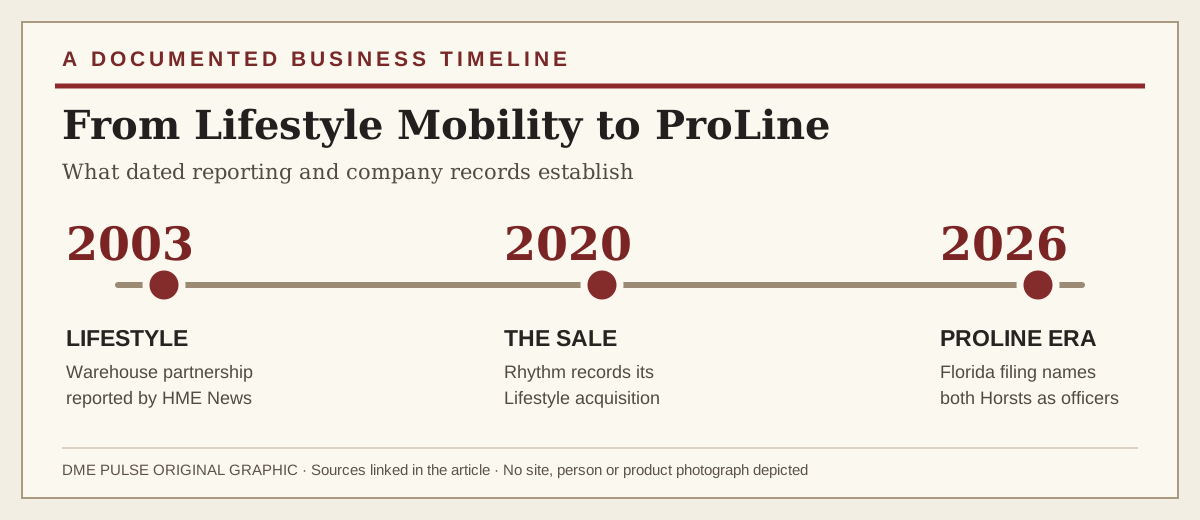
That question became the foundation of his career. Alongside his wife, Collette, Horst built Lifestyle Mobility Aids from the ground up, turning it into a major player in mobility distribution. By 2003, HME News was reporting on Horst’s expansion plans—including a cross-country distribution partnership anchoring Lifestyle in a 64,000-square-foot warehouse in St. Petersburg, Florida. Moving steel and aluminum through regional hubs may seem disconnected from someone waiting for a walker, but Horst understood early on that patient accessibility begins in the supply chain. If dealers couldn't get inventory reliably, people stayed stuck in place.
Two years later, Horst was publicly championing design nuances that competitors often treated as afterthoughts. Speaking to HME News in 2005 about Lifestyle's Royal rollator line, he pushed past generic specs to focus on everyday dignity and convenience: vibrant colors, wider wheels that could handle real turf, and loop-lock brake handles designed so users could comfortably hang shopping bags. His point was clear: mobility devices aren't just medical appliances; people have to live with them, take them into stores, and feel confident using them in public.
The industry shifted, and Horst’s trajectory shifted with it. In July 2020, Lifestyle was acquired by Doug Francis and later rebranded as Rhythm Healthcare. Rather than retiring, Horst launched his next venture: ProLine Medical, operated out of St. Petersburg under Horst Enterprises.
Building a company from scratch a second time is difficult enough, but ProLine soon faced an existential test. A catastrophic fire tore through their St. Petersburg facility, wiping out essential inventory, disrupting operations, and threatening to derail the young company entirely. In an industry where a missed delivery can mean a patient is left without mobility, an event of that scale can shutter a business for good.
Instead, Horst and his team rebuilt. They adapted sourcing, reorganized fulfillment, and kept moving forward, treating the rebuild not as an end point, but as another operational hurdle to clear.
Today, ProLine is back to putting equipment into the hands of providers and families. Take their 810 Kensington rollator: on paper, its 23¼-inch frame, 15-pound carry weight, and 300-pound rating hit the sweet spot for portable independence. Those measurements give families concrete numbers to measure against doorway frames and car trunks, even if no spec sheet can ever replace an in-person clinical fit.
At the same time, expanding into powered mobility brings its own learning curve. On ProLine’s site, a listing for the Stealth Carbon power chair still reflects specs carried over from an M30 model—a reminder that as the company grows its catalog, dealers and clinicians rely on exact, verified configurations before committing capital.
At the end of the day, an equipment choice isn't made on an invoice or a website. It comes down to real-world friction: Can a caregiver lift it into the trunk? Does it clear the bathroom threshold? Who picks up the phone when a wheel or controller needs service?
Decades ago, nurses walked into a uniform shop looking for ways to make their patients' daily lives a little easier. Across warehouse expansions, acquisitions, a devastating fire, and a clean rebuild, the setting has changed, but Horst’s core assignment hasn't: delivering equipment that people can actually use, afford, and rely on when they get home.